Hello and welcome to Part 2 of our series on Work-Life Balance.
Yesterday we explored work… and life and the way that every aspect of life is involved in creating balance. Today we’re taking a look at the nature of balance itself. What might be significant about the fact that work-life is a balance?
When something is perfectly in balance, the dictionary definition is that its weight is completely evenly distributed. So when work and all the other elements of life feel in balance, there’s a sense of the weight or priority you give to each element being even or appropriate. The mix of work, and all the elements of the balance wheel are right for you at that point in time.
The other fundamental of balance is that it is possible for something to affect that balance, making it wobble or unbalance. Unlike a fixed structure, something (or someone) that is in balance is sensitive to shifts in their environment: If something changes internally or externally there’s movement and the balance shifts.
Tip #2 Achieving balance is not a one-off activity. To maintain balance, expect to make adjustments.

So there’s adjustments to be made whenever something changes – usually a small adjustment, sometimes something bigger. Stuff will happen, wobbles are natural, the old balance point was good but might not work any more because you, and the contents of your life, have moved on.
Now to consider what balance is like when there aren’t any obvious changes going on. Yep, balance is just as important when you’re on an even keel too!
Do you remember what it feels like to balance on one leg? Holding that balance involves many different muscles working. It is not a passive balance, you’re actively involved in creating it. You might find it helpful to have some support initially, then the more often you practice, the stronger you get and the balancing gets easier.
The same is true for work-life balance. You create the balance, you maintain it daily, provide nurture and practice so that you build strength in balancing.
Tip #3 Work-life balance is dynamic, requiring you to be alert to what’s going on, develop your balancing strength and be ready to make adjustments
There’s also different ways things can balance. In particular, there’s easy ways to balance, and there’s hard ways. Like attempting to balance a triangle on its pointy tip instead of one of the flat sides, the stability of your balance is also about how you choose to create balance, discovering where the natural balance is. Trying harder to balance on a pointy tip does not make a pointy tip either stable or easy to balance on!
Tip #4 Look out for what feels easy to do and check whether that could help your balance
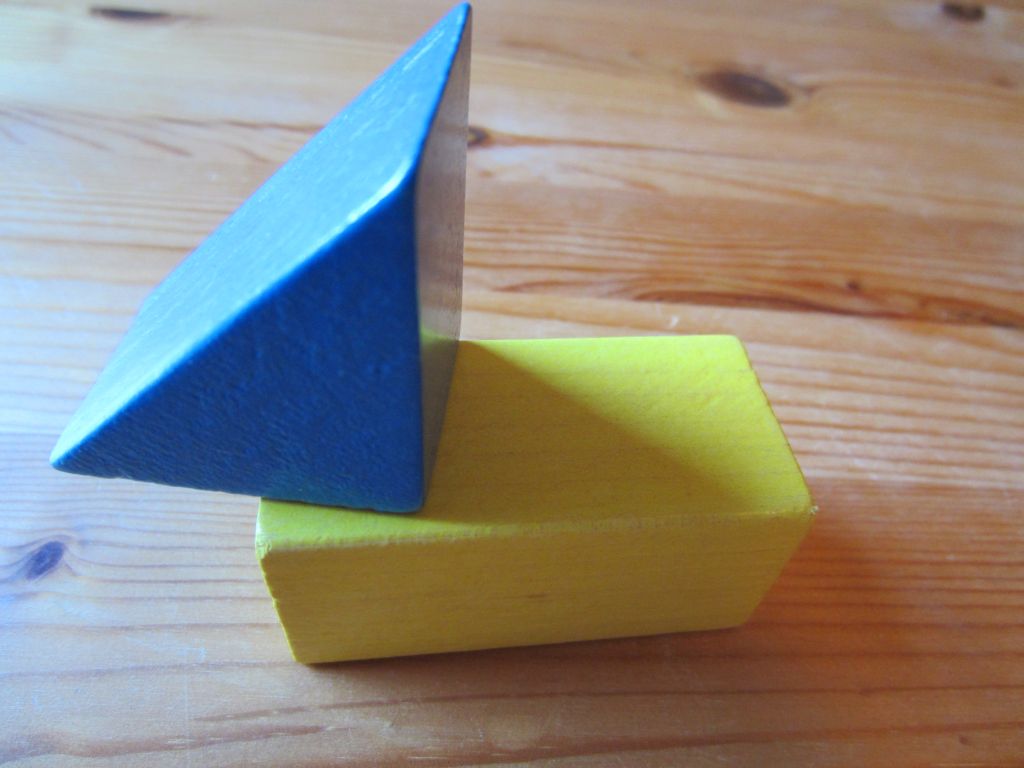
Balance is a skill. It becomes easier with practice. It becomes easier when you are alert for changes and take responsible action when needed. It becomes easier when you do a greater proportion of “what comes naturally.”
For today, I challenge you to do one little thing that helps your sense of balance. It can be as small as you like… what will you do?
Next: How to use fear well : what to do if you know the step you want to take but it scares the wotsits off you.
———————————————————————————————————————–
More to… work life balance
No metaphors were harmed in the writing of this post
Some might have got a bit mixed up


