Trwyn Tal retreat

Recharge, refocus, relax

Recharge, refocus, relax in the Welsh mountains

  • Home
  • Mountain Retreats
    • Welsh Mountain Retreats
    • Self Catering
    • Covid-19 update
  • About
    • About Sarah
    • About Trwyn Tal
  • News
  • Contact

What’s most important to you?

January 20, 2012 By Sarah Maliphant

Today we explore one the most potent fuels for Work-Life Balance: Knowing what’s most important to you.

At any point in time, we each have our own particular recipe for life, made up of the things that matter most to us, our values. Our values help us make choices about what we commit to and define the qualities that make us who we are. They’re the driving force behind why we do what we do.

The degree to which we honour our core values is a significant factor in our work-life balance, how easy it is to take action, and how well our decisions support the direction we want to go in.

Tip #8 For balance, move towards the point where what you do and how you do it are in line with your values

Values are not material things like “car”, “family” “holiday” and “£x thousand pound salary.” Our values describe what we get from these things, what makes them important for us. So for example, a car may give us a sense of status, success, luxury, safety; our salary may represent security or freedom – those kind of things are the values.

The pecking order of these values will also have a big effect on our choices, and how sustainable our balance is. Actions and decisions that are consistent with our values are easier to address. Actions and decisions that threaten one of our values can leave us feeling stuck, angry, choosing to procrastinate or do nothing, and experiencing every kind of Yuk! you can imagine.

In short, a whole bunch of things get easier by making choices and taking actions that are in line with our values.

Tip #9 Be clear about your values, and decision making becomes a whole lot easier.

So, how clear are you about what your values are?

You can spot your values by thinking about things that make you really happy (when you are receiving something that you value) and when you’re livid (someone or something has just stomped all over one of your values).

If you’re not clear or it’s been a while since you thought about your values, here’s a little exercise to that’ll help – just click on the Values link to see or download the document.

This is a quick, instinctive exercise. Get a first impression of the values that guide you, then read on to see how they can help your work-life balance:

What do you value?

How to use your values for work-life balance

Firstly, take a look back at your Balance Wheel from Day 1 – how do the segments that you’re most satisfied with line up with your values? How about the areas you’re least satisfied with?

If you are currently experiencing an area of difficulty, it could be because there’s something you currently need that you are not valuing highly enough (e.g. financial security, time, fun, love…) or have not addressed in a way that suits you.

Example

Someone experiencing dissatisfaction with their finances may have values like generosity, fun and spontaneity way higher up their value hierarchy than for example, financial security, comfort or personal development.

What do I do?

You do not have to change your values! They are part of what makes you tick, and trying to be something you’re not – well, you can imagine what that might do to your balance! What you may want to do is to increase your focus on a particular value, or move its position within the hierarchy.  But if that doesn’t feel right, don’t do it.

You can also use you current values to come to the aid of the “problem” area, by looking for a solution that fits your values. So in our example above, we’d be looking to improve the financial situation in a way that feels generous, fun and provides plenty of opportunities for spontaneity. What would that look like?

Tip #10 Respect your values and use them to help your balance

So, to entirely misquote JFK: Ask frequently what your values can do for you – and what you can do for your values!

Next: Moving towards work-life balance

———————————————————————————————————————–

More to… work life balance

Inspiration for Work-Life Balance

January 19, 2012 By Sarah Maliphant

Hello and welcome to Part 4 of our series on Work-Life Balance.

We’ve looked at  work… and life , explored how to achieve balance, and highlighted some ways to handle stuff that scares the wotsits off you.

Today it’s time to think about what will inspire you as you create and maintain your particular balance. You don’t have to go it alone, there’s a world of support out there! What will you go looking for? Who do you know that will listen and support you? What can you read or watch?

So here’s my personal top 5 work-life balance resources. You may find them useful too, or they may serve as a taster of what’s out there. Main thing is – whatever you think might help you, go find it!

Prioritising
If you’re overwhelmed by the sheer amount of stuff you need to do or you’re struggling to decide what to do first, Stephen Covey does a brilliant demo on how to manage your time and prioritise. It makes me chuckle, it’s a simple concept and it’s a fundamental for balance:

Do the big rocks first

i.e. Ensure you make space for the important stuff, then fit the day to day bits & bobs in.

Lead your self
Clear motivation and knowing why you want what you want can do wonders for getting you into action. Are you clear about your reasons? Simon Sinek does a wonderful talk on getting into action, whether you’re leading your self or others. The concept is sooooo beautifully simple – and so powerful.

Start with the why

Incidentally, the TED talks website is a rich source of pretty much everything inspriational, so if it’s new to you, it’s definitely worth a look around.

It’s the way you think
How you think about work is just as much a part of your balance as making practical changes. Fish! is a true story about fishmongers in Seattle finding a way to make their work more fun. It’s part true, part fable and is packed with simple principles to follow.

Fish! By Stephen C Lundin, Harry Paul & John Christensen

Strengths
Do you know what your natural strengths are? Are you making full use of them at work and in the rest of your life? Sometimes the things that we are best are at the hardest to see, because they come so effortlessly. This little book and it’s associated on-line profiling tool will help you check your talents out and understand ways that you can utilise them.

Strengths Finder 2.0 by Tom Rath

Bertie Cat using one of his natural strengths

The work you were born to do
If you’re seeking work that you love, work that means more to you than just a way to earn money, take a look at the Nick Williams work. In particular:

The work we were born to do by Nick Williams

The business you were born to create by Nick Williams

What else would inspire and support you? Who can you talk to, listen to, what else could you learn, watch or read about?

Tip #7 Surround yourself with whatever supports and inspires you

Happy browsing!

———————————————————————————————————————–

More to… work life balance

How to use fear and discomfort well

January 18, 2012 By Sarah Maliphant

Hi and welcome to Part 3 of our series on Work-Life Balance

Today’s the day we look at fear – fear and all its relatives like nerves, worry, anxiety, discomfort, and the good old Totally Bricking It. What’s fear doing in a work-life balance series? Well, creating your work-life balance starts with looking at where you really are right now – that in itself can be a shocker if you’ve been studiously ignoring yourself for a while.

It’ll also involve you making changes to your daily life – mostly small, sometimes big. At any point in that process, you may encounter something that causes you some concern, worry, or anxiety. You may even come across something that initially scares the wotsits off you, as well as being something you’d love – things like changing job or career, starting to date again, going self employed etc. are pretty good at that.

All those fearful-type feelings have a purpose. The aim today is to understand their purpose and value to you so that you can use them well in creating your work-life balance.

Fear & Discomfort as a Guide
Fearful feelings are all signals that flag up situations where something potentially (N.B. POTENTIALLY) not OK for you requires action to make it OK. The fearful emotions are largely about the future, which is fab because that means there’s the chance for you to do something about it.

Discomfort may be current – flagging up something you need to change in your current balance – or it may be imagined in the future and flagging something you’ll need to address. Either way, check out what exactly it is that bothers you, and find out what you can do to address it.

Fear as a blocker – and safety net
Unaddressed fear can be what holds you back from considering or making changes that you know could be beneficial: The risks of making the change outweigh the discomfort of your current balance, and it’s a bit of “Better the devil you know.” Good news – There’s a lot of wisdom in not moving forward until you have what you need in place. More good news – the risks do not have to be a show stopper if you take a good look at whatever is scary and find solutions you’re ok with.

Tip #5 Take a good look at any changes that you want but also feel scary. What do you need in order to make it OK for you?

Scary and fun – with proper protection

Fear as a motivator to take action
Fear can also be great at getting you into action. You don’t have to use fear to get into action, but if something has got that bad before you act, you better pay attention! Many people may be using this tactic right now to complete their tax returns online. In work-life balance, fear of damaging your health, your relationships, your career can sometimes be the trigger for taking action.

However, fear is lousy at keeping you moving. Imagine it – you’ve moved away from whatever situation was feeling critical, you start to feel more comfortable, life’s feeling better again and you just kind of hang out there for a bit. So if the full monty work-life balance change you seek is still ahead of you, you’ll need to get your motivation from how much you want what’s ahead, not just getting away from what was unpleasant.

Tip #6 If your motivation is to get away from some imbalance, use that to get you going and be sure you have something so yummy to move towards that it keeps you moving forward.

Fear, anxiety, worry, discomfort etc. may not be nice feelings to experience, but they’re there for such a cool reason. Your job is to pay attention to them, understand what they’re warning you about, and then go and suss out what you need to do.

Next: Inspiration for work-life balance

——————————————————————————————————————————

More to… work life balance

The Nature of Balance

January 17, 2012 By Sarah Maliphant

Hello and welcome to Part 2 of our series on Work-Life Balance.

Yesterday we explored work… and life and the way that every aspect of life is involved in creating balance. Today we’re taking a look at the nature of balance itself. What might be significant about the fact that work-life is a balance?

When something is perfectly in balance, the dictionary definition is that its weight is completely evenly distributed. So when work and all the other elements of life feel in balance, there’s a sense of the weight or priority you give to each element being even or appropriate. The mix of work, and all the elements of the balance wheel are right for you at that point in time.

The other fundamental of balance is that it is possible for something to affect that balance, making it wobble or unbalance. Unlike a fixed structure, something (or someone) that is in balance is sensitive to shifts in their environment: If something changes internally or externally there’s movement and the balance shifts.

Tip #2 Achieving balance is not a one-off activity. To maintain balance, expect to make adjustments.

Balance: includes abilty to move

So there’s adjustments to be made whenever something changes – usually a small adjustment, sometimes something bigger. Stuff will happen, wobbles are natural, the old balance point was good but might not work any more because you, and the contents of your life, have moved on.

Now to consider what balance is like when there aren’t any obvious changes going on. Yep, balance is just as important when you’re on an even keel too!

Do you remember what it feels like to balance on one leg? Holding that balance involves many different muscles working. It is not a passive balance, you’re actively involved in creating it. You might find it helpful to have some support initially, then the more often you practice, the stronger you get and the balancing gets easier.

The same is true for work-life balance. You create the balance, you maintain it daily, provide nurture and practice so that you build strength in balancing.

Tip #3 Work-life balance is dynamic, requiring you to be alert to what’s going on, develop your balancing strength and be ready to make adjustments

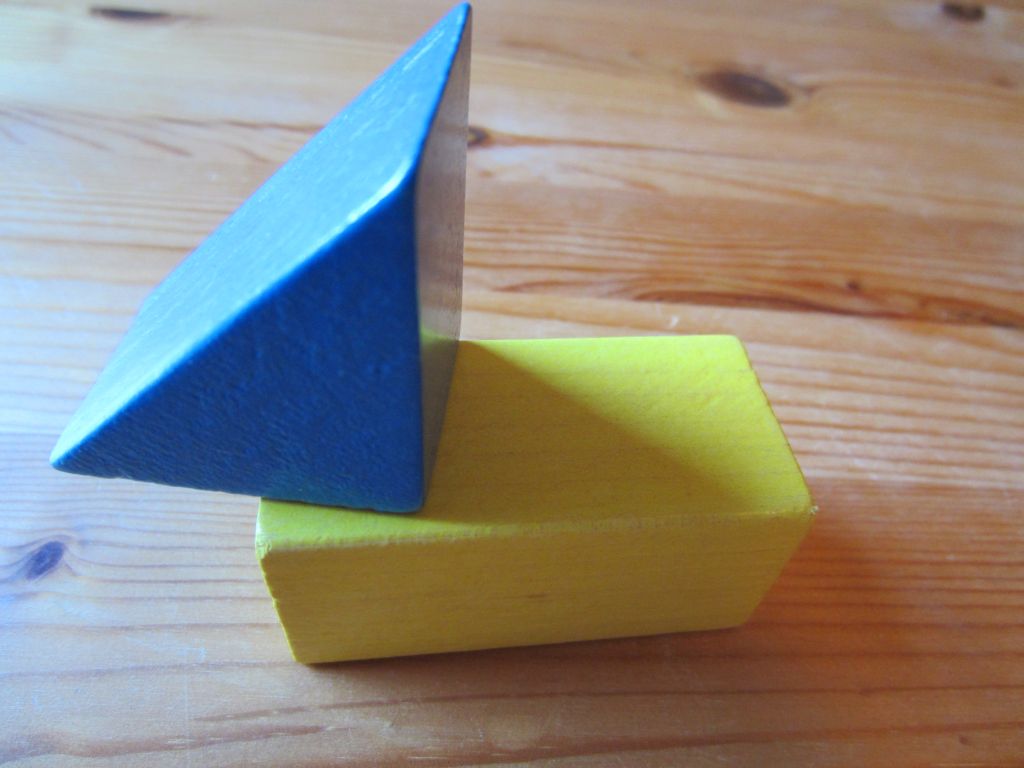
There’s also different ways things can balance. In particular, there’s easy ways to balance, and there’s hard ways. Like attempting to balance a triangle on its pointy tip instead of one of the flat sides, the stability of your balance is also about how you choose to create balance, discovering where the natural balance is. Trying harder to balance on a pointy tip does not make a pointy tip either stable or easy to balance on!

Tip #4 Look out for what feels easy to do and check whether that could help your balance

Pointy tips: Rubbish to balance on

Balance is a skill. It becomes easier with practice. It becomes easier when you are alert for changes and take responsible action when needed. It becomes easier when you do a greater proportion of “what comes naturally.”

For today, I challenge you to do one little thing that helps your sense of balance. It can be as small as you like… what will you do?

Next: How to use fear well : what to do if you know the step you want to take but it scares the wotsits off you.

———————————————————————————————————————–

More to… work life balance

No metaphors were harmed in the writing of this post

Some might have got a bit mixed up

« Previous Page
Next Page »

Recent posts

  • World’s Most Scenic Railway Journeys
  • Valentine Courgettes
  • Welsh Cheese Scones

Covid-19 update

Blog categories

Copyright © 2026 · Website design by Tim Gray